

If you’re comparing prices before booking a ride to or from an airport in North Carolina, the honest answer is: it depends on which airport, which vehicle, and which pricing model you’re looking at. But the short version most people actually want is this — a flat-rate sedan transfer in North Carolina typically runs $75 to $95, an SUV runs $90 to $135, and hourly chauffeur service starts around $70 to $75 per hour for a sedan with a 3-to-4-hour minimum. Below, we break that down airport by airport, explain what actually moves the price, and show you how flat-rate car service compares to rideshare and taxi once surge pricing enters the picture.
The Quick Answer: NC Airport Car Service Pricing at a Glance
| Service Type | Typical Price Range |
|---|---|
| Sedan, point-to-point (flat rate) | $75 – $95 |
| SUV, point-to-point (flat rate) | $90 – $135 |
| Sprinter van, point-to-point | $115 – $150+ |
| Sedan, hourly chauffeur service | $70 – $75/hour (3–4 hr minimum) |
| Sprinter van, hourly chauffeur service | $90/hour (3–4 hr minimum) |
These ranges hold fairly steady across Raleigh-Durham (RDU), Charlotte Douglas (CLT), Piedmont Triad (GSO), Asheville Regional (AVL), and Fayetteville Regional (FAY), with the exact number depending on distance, vehicle, and time of day. Here’s what’s actually driving those numbers.
What Actually Determines Your Price
1. Pricing model: flat-rate vs. hourly vs. metered
This is the single biggest factor, and it’s also where most of the price confusion comes from. North Carolina ground transportation breaks into three pricing structures:
- Flat-rate (point-to-point): You’re quoted one price before you ride — airport to hotel, home to airport, etc. The price doesn’t move regardless of traffic, wait time at baggage claim, or how long the trip actually takes.
- Hourly (chauffeur service): Used for multi-stop days, weddings, events, or anything where the vehicle and driver stay with you rather than dropping you off once. Almost always has a 3-to-4-hour minimum.
- Metered/dynamic (taxi and rideshare): The price is calculated in real time based on distance, time, and — critically — demand. This is the model that produces surge pricing.
Flat-rate is the standard for professional car service in North Carolina specifically because it removes the variable that causes the most frustration: not knowing your final cost until the ride is already over.
2. Vehicle class
- Luxury sedan (1–3 passengers) — the baseline rate, suited to solo and business travelers
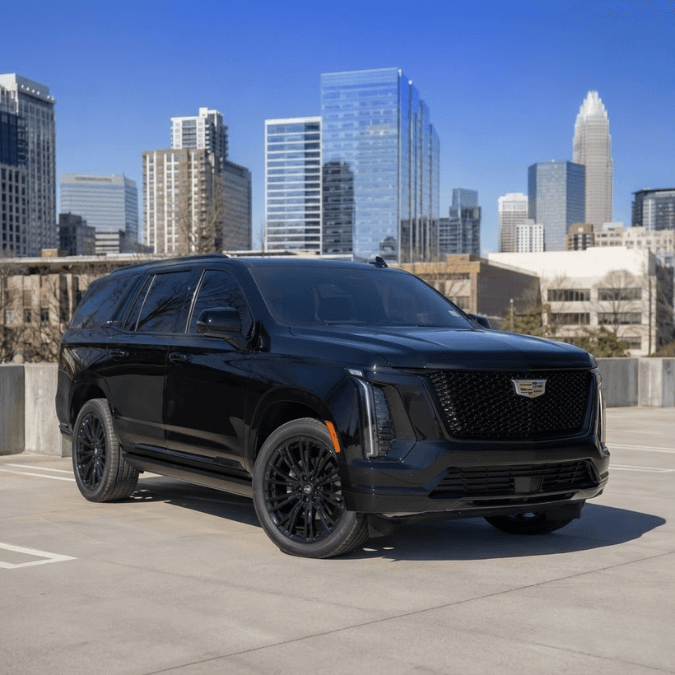
- Premium SUV (1–6 passengers, more luggage room) — typically $15–$25 more than the sedan rate
- Sprinter van (up to 14 passengers) — priced higher but often cheaper per person than booking multiple sedans for a group
3. Distance and which airport you’re using
Triangle pricing (RDU to Raleigh, Durham, Cary, Chapel Hill) and Triad pricing (GSO to Greensboro, Winston-Salem, High Point) both start around the same $80 sedan baseline, since the core metro areas sit a similar distance from their airports. Charlotte (CLT) trends slightly higher for SUVs, given the size of the metro and the spread of business districts like Uptown, SouthPark, and Ballantyne. Longer regional routes — Asheville to Biltmore Forest, or Fayetteville to a Fort Bragg-area address — stay flat-rate but naturally scale up with mileage.
4. Time of day and season
Early-morning and late-night pickups (common for Southwest’s early RDU departures or redeye arrivals at CLT) usually carry a modest after-hours adjustment. Seasonal demand spikes — High Point Market in the Triad, Biltmore Estate’s Christmas season in Asheville, NASCAR weekends in Charlotte, the ACC Tournament in Raleigh and Greensboro — don’t change flat-rate pricing itself, but they do mean booking 3–4 weeks ahead to guarantee your preferred vehicle, since availability (not price) is what tightens up first.
What’s Included in the Airport Transportation Price
A flat-rate quote in North Carolina should already include the chauffeur, fuel, standard wait time, meet-and-greet, bottled water, and gratuity — that last detail matters, because gratuity is one of the most common hidden add-ons in this industry. Always confirm whether gratuity is built into your quote before you book; if it isn’t, a standard tip runs 15–20% of the fare.
What should not show up as a surprise: surge multipliers, “cancellation” fees for a driver who couldn’t find you, or a different price at drop-off than what you were quoted at booking. Those are signs of a metered or rideshare-style model, not flat-rate car service.
Car Service vs. Rideshare vs. Taxi: Where the Real Price Difference Shows Up
On a quiet Tuesday afternoon, rideshare can sometimes undercut a flat rate by a few dollars. The problem is that airport pickups rarely happen on quiet Tuesday afternoons — they cluster around rush hour, early mornings, holidays, and exactly the kind of regional events that trigger surge pricing:
- NASCAR weekends and Panthers games pushing Charlotte rideshare fares up near CLT
- The ACC Tournament rotating through Raleigh and Greensboro
- High Point Market flooding the Triad twice a year
- Holiday travel weeks at every airport in the state simultaneously
During any of those windows, rideshare and taxi fares can climb to two or three times their normal rate. A flat rate booked in advance simply doesn’t move — the number you’re quoted when you book is the number you pay, whether your flight lands on time, two hours late, or in the middle of a sold-out concert weekend.
Pricing by Airport
RDU (Raleigh-Durham) — Point-to-point transfers across the Research Triangle (Raleigh, Durham, Cary, Apex, Morrisville, Chapel Hill) start around $80 for a sedan and $90 for an SUV. Whether you’re flying through Terminal 1 or Terminal 2, the flat rate doesn’t change — only the pickup point does.
CLT (Charlotte Douglas) — As one of the busiest hub airports in the country, CLT transfers run a comparable sedan baseline with SUV rates trending slightly higher, reflecting the size of the metro area and the spread between Uptown, SouthPark, and surrounding communities like Huntersville and Ballantyne.
GSO (Piedmont Triad) — Greensboro-area transfers start at $80 for a sedan and $100 for an SUV, covering Greensboro, Winston-Salem, and High Point.
AVL (Asheville Regional) — Asheville-area pricing mirrors the Triad’s structure, with the same $80/$100 sedan/SUV baseline extending out to Biltmore Village, Biltmore Forest, and Biltmore Park.
FAY (Fayetteville Regional) — FAY’s smaller size keeps transfers efficient, with the same flat-rate model applied to Fort Bragg-area and regional routes.
No North Carolina market carries an out-of-area surcharge — the flat-rate structure is consistent statewide, with price differences coming from distance and vehicle class rather than which airport you’re flying through.
How to Get an Accurate Quote
The fastest way to get a real number instead of a range is to book directly. Reserve online or call (910) 248-4652 with your airport, flight details, and destination, and you’ll get a firm, written flat-rate quote in minutes — available 24/7.