
You should arrive at RDU Airport at least 2 hours before domestic flights and 3 hours before international flights. However, timing can vary depending on your terminal, security wait times, time of day, and whether you’re checking bags.
Why Arrival Time Matters at RDU
Raleigh-Durham International Airport serves the fast-growing Research Triangle, and passenger volume shifts sharply throughout the day. Arriving too late can mean long security lines, a stressful sprint to your gate, or — in the worst case — a missed flight after check-in and bag drop close.
Arriving too early has its own small cost: extra time waiting in the terminal. The goal is the right balance, and at RDU that balance depends on a few specific, knowable factors — your terminal, the time of day, and whether you’re checking bags. Get those right and RDU is one of the smoother mid-size airports in the country to move through.
Recommended Arrival Times by Flight Type
General guidelines exist, but your ideal arrival window depends on your specific trip.
Domestic Flights
For domestic travel, arriving 2 hours before departure is the standard recommendation, and it’s what RDU itself advises. That window covers parking or drop-off, check-in and bag drop, security screening, and the walk to your gate.
If you’re traveling with only a carry-on and already have a mobile boarding pass, you can often move through faster — but 2 hours remains the safe default, especially during peak hours.
International Flights
For international departures, arrive at least 3 hours before your flight. International travel involves extra steps: document and passport verification, longer check-in processes, and less predictable lines. RDU’s international service runs through Terminal 2, and the extra buffer protects you against the additional processing time these flights require.
RDU Terminal 1 vs. Terminal 2: Does It Change Your Timing?
RDU has two terminals, and knowing which one you’re using matters for planning.
- Terminal 1 serves Southwest and Avelo. It’s the smaller, simpler terminal — generally quick to move through.
- Terminal 2 serves American, Delta, United, and international carriers. It’s larger and busier, with more concourses and higher passenger volume.
Because Terminal 2 is bigger and handles more traffic (including all international flights), security lines there can build faster during peak departure banks. If you’re flying out of Terminal 2 during a morning or evening rush, lean toward the longer end of the recommended window. If you’re not sure which terminal your airline uses, check your boarding pass — and confirm it the night before, since airline-terminal assignments can change.
The two terminals are connected but sit about a third of a mile apart, so arriving at the correct one saves you a stressful walk with luggage. If you’re arranging a ride, our RDU Terminal 1 car service guide and RDU Terminal 2 car service guide walk through exactly where each terminal’s pickup happens (Zone 1 vs. Zone 8) and what to expect on arrival. For the terminal service pages themselves, see RDU Terminal 1 and RDU Terminal 2.
What Affects How Early You Should Arrive at RDU
Several factors influence how much buffer you actually need.
Time of Day
RDU’s busiest windows are roughly 5–8 AM and 4–7 PM. During these peaks, security waits commonly run 25–35 minutes and can stretch toward 45 minutes on the busiest days. Midday flights (around 11 AM–2 PM) and late-evening departures usually see the shortest lines — often 10–15 minutes.
Day of the Week
RDU sees heavy business travel from Triangle-area companies, which concentrates on Monday mornings and Friday evenings. Weekends and holidays also raise passenger volume. If you’re flying during any of these, add buffer.
Security Wait Times
RDU security is generally efficient — often under 30 minutes — but it’s the single biggest variable in your timing. Waits fluctuate with staffing, passenger volume, and time of day, and even an early arrival can be eaten up by an unexpectedly long line. Checking the MyTSA app before you leave gives you a current read on your specific checkpoint.
Checked Baggage
If you’re checking bags, budget extra time for the airline counter, which can back up during busy periods. Most airlines close check-in and bag drop 30–45 minutes before departure — miss that cutoff and you may not fly, even if you’re standing in the terminal. Carry-on-only travelers can skip the counter entirely with a mobile boarding pass.
TSA PreCheck and CLEAR
Both are available at RDU, in Terminal 1 and Terminal 2. PreCheck lanes move significantly faster — often just a few minutes — and let you keep shoes, belts, and laptops in place. CLEAR uses biometric verification to speed up the ID-check step. If you have either, you can reasonably trim your arrival buffer during off-peak hours, though it’s still wise to keep the 2-hour target during peaks.
One current requirement to note: as of May 2025, all travelers 18 and older must present a REAL ID-compliant license or another TSA-accepted ID (like a passport) to clear security at RDU.
How Long It Takes to Get Through RDU
Exact times vary, but here’s a realistic picture of the steps involved:
- Check-in and bag drop: 10–20 minutes (skip entirely with carry-on and mobile boarding pass)
- Security screening: 10–30 minutes off-peak, up to 45 minutes during busy periods
- Walk to your gate: 5–15 minutes, longer in Terminal 2’s larger layout
Stacked together, these add up quickly — which is exactly why the 2-hour domestic buffer exists. RDU’s ticket counters generally open around 4 AM, and the TSA security checkpoint opens at 4:30 AM, so very early departures are well supported.
Getting to RDU On Time
Your arrival at RDU doesn’t only depend on airport processes — it depends on getting to the airport. Triangle traffic on I-40 and NC-147 can slow down during rush hour, and a delay on the road eats into your buffer even if you left with time to spare.
RDU is centrally located between Raleigh, Durham, and Chapel Hill, with typical drive times of 20–45 minutes from Triangle cities depending on where you’re starting and the time of day. Planning your transportation in advance removes one of the biggest sources of arrival-time uncertainty.
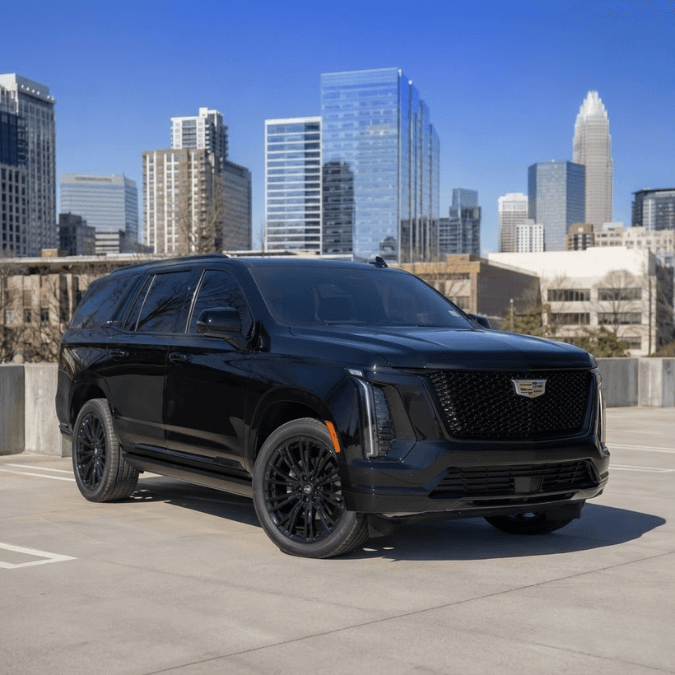
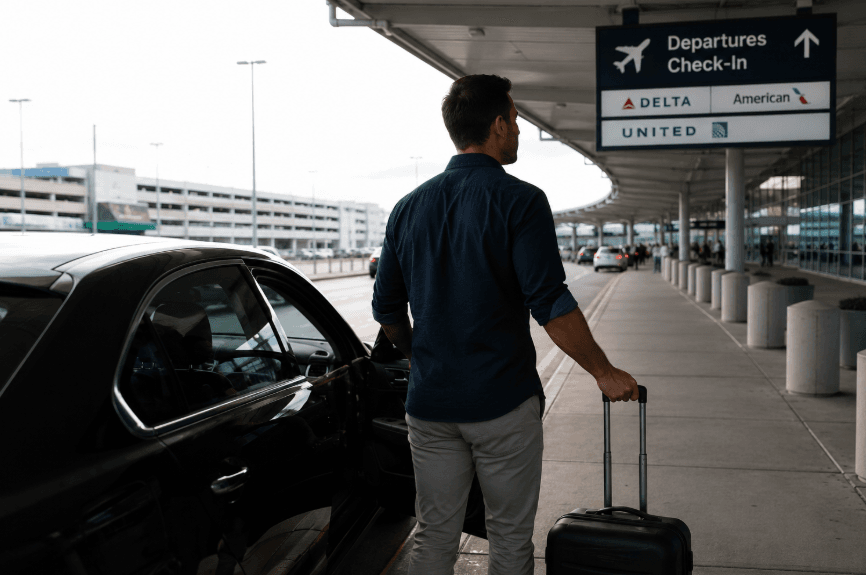
For travelers who’d rather not deal with parking, traffic timing, or curbside stress, a prearranged black car service handles the drive with real-time traffic awareness and drops you at the correct terminal’s departures level — so the only clock you’re watching is the one at security. Depending on your terminal, our RDU Terminal 1 car service guide and RDU Terminal 2 car service guide cover pickup and drop-off specifics for each.
When You Should Arrive at RDU Even Earlier
Add extra time beyond the standard recommendations if you:
- Are traveling during holidays or peak seasons (RDU’s busiest months are July, August, and December)
- Are flying internationally
- Are checking multiple bags
- Are traveling with children or pets
- Are unfamiliar with RDU or unsure of your terminal
- Are flying out of Terminal 2 during a morning or evening peak
In these cases, arriving 2.5–3 hours early for domestic and 3.5–4 hours for international gives you a comfortable buffer.
What Happens If You Arrive Too Late at RDU
Arriving late can cascade into real problems. You may hit a long security line with no time to spare, or miss the airline’s baggage and boarding cutoffs — typically 30–45 minutes before departure. Once those deadlines pass, you may be denied boarding and forced to rebook, which is both costly and stressful. When it’s close, the certainty of a pre-scheduled ride to the airport is worth far more than the few dollars it saves to cut it fine.
What If You Arrive Too Early?
Arriving early is the far safer mistake. The main downside is extra waiting time, especially if your gate isn’t assigned yet. But RDU has solid dining, comfortable seating, and shops in both terminals — Terminal 2 in particular has a wide range of options — so the wait is easy to fill. For most travelers, a relaxed early arrival beats a rushed late one every time.
Tips for a Smooth RDU Arrival
A few simple habits make the whole day easier:
- Check your flight status before leaving home for delays or gate changes
- Confirm your terminal the night before — Terminal 1 (Southwest, Avelo) or Terminal 2 (American, Delta, United, international)
- Check in online and use a mobile boarding pass to skip the counter
- Bring a REAL ID-compliant ID that matches your ticket
- Check the MyTSA app for current security wait times before you go
- Give yourself extra buffer during peak hours, holidays, and Monday/Friday business rushes
- Plan your ride in advance so road traffic doesn’t eat into your timing
A Smarter Way to Plan Your RDU Arrival
Rather than aiming for the bare minimum, think in terms of comfort and predictability. Building in enough time lets you move through parking, check-in, and security without rushing — and turns the start of your trip into a calm one instead of a scramble. A well-planned arrival, from the drive to the gate, is the difference between a stressful morning and a smooth one.
People Also Ask
Krownkey Unlimited provides flat-rate car service to and from RDU Terminal 1 and Terminal 2, with real-time flight tracking and curbside drop-off at the correct terminal — so you arrive with time to spare. Reserve your ride → or call (910) 248-4652, available 24/7.
Note: Arrival guidance is general; always confirm current TSA wait times and your airline’s specific check-in cutoffs before travel.